Investigating the Evolution of Widespread Marine Invertebrate Systems in Response to Anthropogenic Change
Research
Postdoc Research with Dr. Katie Lotterhos
Are there parallel signals of adaptation to environmental stressors across Eastern US oyster populations?
My postdoc research is grounded by a large-scale field experiment with the Eastern Oyster (Crassostrea virginica). The Eastern oyster spans a broad environmental gradient across the Eastern US, but previous work has identified population-level differences in the gulf compared to the Atlantic. Building on a large-scale field experiment, I am analyzing low coverage WGS data to assess genomic differences between six wild and two selection line populations in two common gardens. One common garden historically has higher salinity and higher disease pressure, while the other has lower salinity and lower disease pressure. I am also investigating the role of genotypic redundancy, or the use of the same genotypes, across genetic backgrounds in response to common gardens.
phd research with dr. rachael bay
How do urban-associated pollutants affect larval development and gene expression patterns?
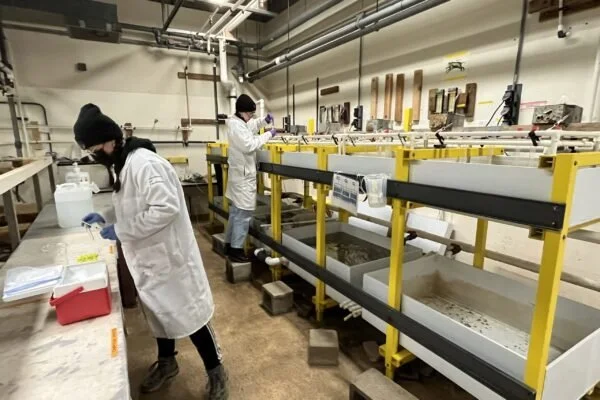
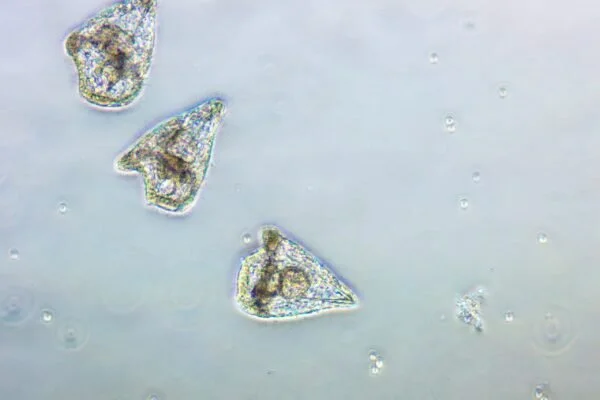
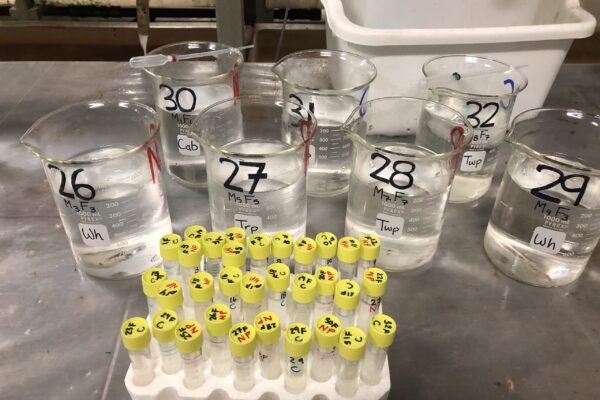
EDCs such as alkylphenols appear in many household products and are often found in high concentrations in urban waterways (Maruya et al., 2014). Exposure to these toxins have been found to result in developmental abnormalities in S. purpuratus larvae, potentially affecting population dynamics. However, we do not know how tolerance or susceptibility to EDCs might vary among populations with different levels of exposure. I first established a baseline of what laboratory exposure of this chemical does to S. purpuratus, where I conducted a larval exposure study. I found that overall exposure resulted in altered larval morphology and shifts in gene expression patterns in S. purpuratus (Armstrong et al., 2025 Ecol & Evo). These findings shaped my next dissertation chapter, where I created an average of 12 families per population for both my two urban and two nonurban sites to disentangle the physiological impacts of prolonged exposure, or historical exposure, to urbanization. Interestingly, I found that while the earlier developmental stages showed strong negative impacts to exposure, there are distinct gene expression patterns (Fig 1 inset D) as well as differences in size and survival and associated with individuals from urban environments (Armstrong et al., 2026 in review at Am Nat). There were clear patterns of groups of genes that differentiated with both treatment and urbanization. More broadly, I discovered that environmental history alters developmental and transcriptomic larval responses.
phd research continued
How can adaptation occur with high gene flow? How does the urban environment as a whole affect evolution in urban marine invertebrate populations?
I leveraged the Pacific purple sea urchin (Strongylocentrotus purpuratus), a widespread marine invertebrate ranging from Alaska to Baja California, as a model system for two large-scale population genomics studies. This species has been shown to have high gene flow due to pelagic larval dispersal, with negligible population structure. Early in my PhD I collaborated with the California Conservation Genomics Project and we found that despite high gene flow, adaptation to small spatio-temporal scales is possible, with signals of adaptation identified across urchin populations to subtidal versus intertidal habitats. I then dove into investigating if this pattern holds true to other environmental conditions, such as urbanization, which are novel in the evolutionary history of urchins. I collected spine tissue from urchin populations across three urban regions (Victoria, B.C., Los Angeles and San Diego, CA) to identify genomic signals for adaptation to urban environments. Using this paired urban-nonurban site design, I will be able to disentangle genetic variation associated with geographic proximity and genetic variation due to high selection in marine urban environments and identify selection in marine urban environments. I again identified no population structure, despite these sites spanning >2,000km, and no adaptive outliers associated with region. I identified distinct outliers associated with urbanization in each of the three regions, and while there was no “urban SNP” overlapping across all three regions, I identified distinct polygenic yet parallel signals of urban adaptation across the sampled range using several approaches. My findings in this study again highlight the role of fine-scale environmental gradients in driving adaptive variation (Armstrong et al., 2025 in Review at Molecular Ecology), and suggest that adaptation over small scale urbanization gradients is possible even in high gene flow systems and the polygenic architecture of adaptation is, at least in part, parallel.